
Curious about Course?    Get Free Demo Class Now

Tag: Interior Design

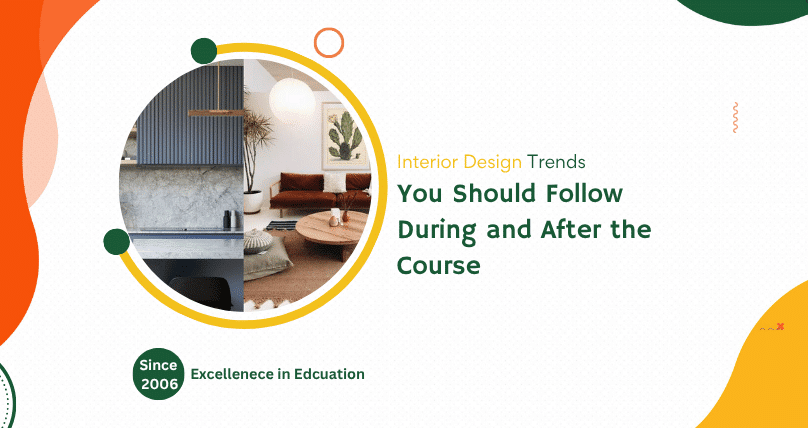
Interior Design Trends You Should Follow During and After the Course

Have you just finished an interior design course? Then, the actual work will start after the study phase. This field is constantly changing, and you have to see and hear what the trends are during your studies and after the profession if you want to be relevant. 

Interior Design Trends You Should Follow During and After the Course

The interior design course in Ahmedabad you choose should help you understand the latest trends and explore opportunities to advance your career in interior design.

The present blog depicts the latest trends in Indian interior design and how they can be integrated into your work as a student and as a professional. If you have pursued an interior design course, then these insights will be helpful in your final projects and to win over clients later.

1. Earthy Tones & Textured Finishes Making a Comeback

In 2025-26, India’s warm, earthy color palettes are dominating: terracotta, mustard, rust, olive, deep rust-brown, sand, etc. 

Alongside color, walls and ceilings are no longer smooth, white, or flat laminated surfaces. Textured finishes, such as lime wash, clay paint, stone cladding, and decorative putties, are being used to expressiveness and bring a natural warmth. 

What to do as a student / fresh graduate:

  • When doing projects, experiment with sample panels showing texture (e.g., clay plaster or limewash) so you understand material behavior and cost.
  • Include earthy palettes in your presentation boards. Clients in Ahmedabad often appreciate color tones that respond well to strong sunlight. Nowadays, it is essential to practice shading/lighting effects to create the best space.

2. Biophilic Design & Indoor-Outdoor Integration

The connection to nature in houses across India is becoming stronger and stronger: indoor plants, vertical gardens, green walls, large windows, and sliding glass doors.

Biophilic design is not only about aesthetics; it also offers advantages in terms of thermal comfort, ventilation, and mental wellness. The utilization of natural light, ventilation, and landscaping is even being done during the design phase of the project. 

Student / Graduate Tip:

  • In your assignments or portfolios, include cross-section/elevation drawings that highlight placements of shrubs and trees, as well as the provision of daylight through the structure.
  • Identify the local plants that can be grown indoors or on terraces. Understanding the factors of climate and orientation will make your designs more functional and CPD relevant.

3. Sustainable Materials, Local Craft & ‘Indo-Contemporary’ Fusion

The demand for sustainability is increasing: eco-friendly materials, reclaimed wood, low-VOC paints, and products with lower thermal conductivity are some of the things that are being preferred. 

Along with that, the contributions of traditional Indian craftsmanship and local artists (jaali screens, block printing, brass, terracotta, carved wood) are combined with the modern aesthetics (clean lines, minimal structure), resulting in something both recognizable and rooted. The Indo-contemporary style renders interior spaces as simultaneously modern as well as deeply Indian. 

What students should practice:

  • Getting materials from local sources, visiting craftsmen’s workshops, and learning about the cost and durability of traditional materials in modern contexts are some of the things that should be done.
  • In portfolio work for the interior design course in Ahmedabad, always have one project that is based on local art, which will show you know about regional identity, climate, and culture.

4. Multi-Functional Spaces & Flexible Layouts

Because of urban limitations (smaller apartments, shared spaces), the concept of rooms or furniture serving more than one function is gaining importance. For instance, foldable furniture, hidden storage, convertible partitions, rooms that can serve work + rest + living functions. 

Designers are also looking at flexible spatial planning: plan for reconfiguration, modular furniture, and adaptable lighting. Students have to learn about circulation, usage patterns, and ergonomics.

5. Statement Lighting, Curves, & Ceilings as Fifth Wall

Light fixtures are no longer merely functional; they are focal “sculptural” elements. Pendant lights, chandeliers, and custom lighting that react to mood or time of day. 

Curved furniture, arches, and soft edges are taking over from harsh straight lines; ceilings are being treated (wooden battens, textured ceilings, decorative false ceiling work) as significant surfaces.

In your work: 

  • When completing your final project (or internship), suggest a lighting system that has layers (ambient + task + accent) and demonstrate the interaction of lighting with furniture & color. 
  • Draw or create a model of curved pieces or treated ceilings to prove that you can think beyond flat, rectangular spaces. 

6. Smart Technology & AI-Assisted Design

The smart home integration (like automation, sensors, app-based control of lighting, AC, and security) is gradually becoming more popular in India. 

On the AI side, the use of visualization tools (3D renders, VR/AR, generative AI) is increasing in both academia and professional practice. The tools are used in material selection, layout planning, and client presentations, among others. Skill-build for the future: 

  • Learn one or more visualization tools (SketchUp, Revit, 3ds Max, or newer AI/VR tools). 
  • Understand the basics of automation or smart sensors so you can propose intelligent systems in home design. 

Conclusion

If you’ve done an interior design course in Ahmedabad, adopting these trends throughout the course (in the studio assignments, thesis, and internship) will be very advantageous to you. When you finish the course and start to work with clients or firms, these are the exact design directions the market is moving toward. Having previous experience will assist you in providing both thought-leadership and relevance. 

At Kalapurnam Institute, we train not only in the existing styles but also prepare you to shape the future of interior design. Would you like to receive hands-on feedback on your portfolio or investigate how these trends can become your signature? Come along with us and let your designs communicate in the language of tomorrow.

How Interior Design Institutes in Ahmedabad Prepare You for the Real World

Interior designing is the art of curating your dream space with all your heart. The essence of this profession combines creativity, technical skill, and a set of problem-solving activities. Does talent help? For sure.

However, one requires training and industry experience to progress from a design lover to practicing as an interior designer.

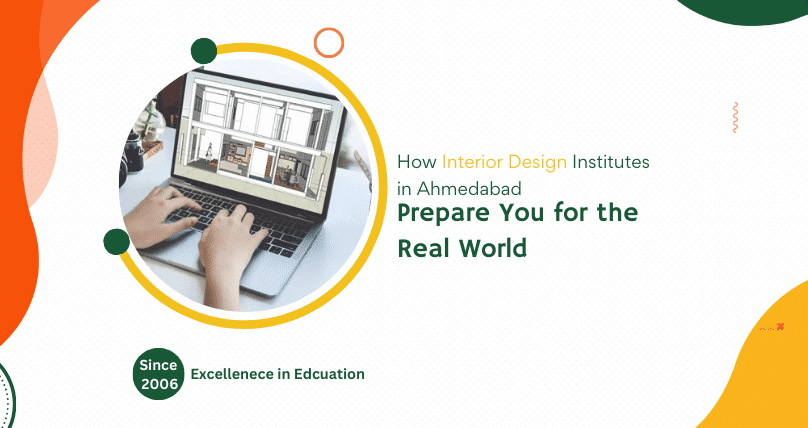
How Interior Design Institutes in Ahmedabad Prepare You for the Real World

With its ancient design culture and ever-expanding urban development process, Ahmedabad has become a prominent city for interior designers. Joining a leading interior design institute in Ahmedabad provides the right education based on a balance between classroom teaching and real-world experience. 

Bridging Theory with Practice

Interior design institutes lay different theoretical foundations for the students. From designing concepts, philosophy, and spatial planning to the knowledge of materials, textures, and color psychology. Yet the true growth occurs when theory converges with practice.

Students apply theoretical classroom learning through real-world projects of model making and live assignments. This bridge from theoretical understanding to hands-on practice aids them in grasping the manner in which design works for real homes, offices, and commercial spaces.

Skill Development in Modern Design Tools

Nowadays, interior designers are dependent on technology. Some of the more well-known applications have to be mastered to create 3D rendering and highly detailed CAD drawings. 

A leading interior design institute in Ahmedabad ensures that students attain equal standards with industry-level applications like AutoCAD, SketchUp, Revit, and Photoshop. With hands-on training on these applications upon completing their course, students can gain experience-oriented training. One can directly involve oneself in handling client projects independently as well as professionally.

Exposure to Industry 

Design is a balance between meeting the client’s requirements and budget constraints and creativity. Institutes in Ahmedabad provide their students with opportunities to interact with industry personnel in the following ways:

  • Guest Lectures – Insights of working professionals, including architects, designers, and project managers.
  • Site Visits – Direct educational visits to sites, showrooms, and design studios.
  • Workshops – Special programs on lighting design, sustainable interiors, and latest materials.

This exposure educates the student on how the industry functions, from concept to execution.

Internships and Live Projects

Of all working environments that may be a stepping stone to industry experience, internships provide the best.

The following are garnered from exchanges with top design firms for securing internships:

  • Collaborate on real client projects.
  • Working on budgets and vendor coordination.
  • Experience the fast-paced nature of design studios.

These internships add to technical and interpersonal skill sets. This helps to create a network of professionals that can yield future job offers.

Building a Strong Portfolio

The portfolio is an identity in interior design. During the course, students are exposed to several assignments involving residential layouts, commercial interiors, exhibition setups, and sustainable design concepts. 

The institutes orient students to help them organize these works into a professional portfolio representing their creativity, as well as technical knowledge. Thus, students graduate with a portfolio that is really attractive to employers and clients alike. 

Problem-Solving and Adaptability

Design projects often encounter roadblocks such as spatial constraints, budget limitations, or unforeseen client demands. Institutes teach their students to think critically and adapt to changing requirements without compromising the design quality.

Properly expressed real challenges in the teaching room help the students in learning how to make good decisions, talk to clients, and perform a series of tasks all in one go. These skills are vital for a good designer in the swiftly changing realm of design.

Final Word

Choosing a good institute should be your first step to fulfilling an interior design career. A leading interior design institute in Ahmedabad not only teaches interior design but also opens the doors of industry exposure, sharpens technical skills, and gives wings to creativity through hands-on working experience.

If interior designing is your passion, then seed your career at Kalapurnam Institute. Our institute nurtures you with real-life scenarios and establishes connections with industry experts. We aim to help you transform your passion for design into designing spaces of inspiration.

A Day in the Life of an Interior Design Student at Kalapurnam Institute

Ever wondered what it takes to put oneself in the shoes of an aspiring interior designer? If your Pinterest boards are filled with dreamy spaces, you sketch floor plans during lectures, you might just be at the best interior design institute.

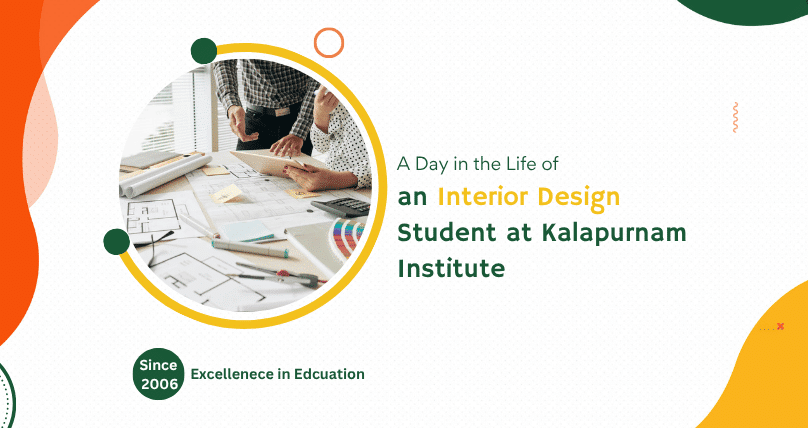
A Day in the Life of an Interior Design Student at Kalapurnam Institute

Let’s give you a sneak peek into a day at Kalapurnam Institute, the leading interior design institute in Ahmedabad, as an interior design student. Know how they learn, play with aesthetics, structure and structure with spontaneity, and imagination with industry.

Rise and Design: Morning Burst of Inspiration

No alarms go off; ideas do. Morning waves at Kalapurnam begin with a spontaneous session of scrolling through Pinterest, Elle Decor, or Instagram reels of dreamy spaces (totally guilty!). 

Our students begin their day with chai and design inspirations. From the archway of some old Haveli to the symmetry in a minimalist workspace, the best hits come in the morning. 

Once on campus, the vibes turn very electric. Being the leading interior design institute in Ahmedabad, Kalapurnam doesn’t just teach design; it lives design. Morning classes dive into theory, but never boring! It starts from spatial planning to understanding textures; students get a deep dive into the fundamentals.

Sketch. Strategise. Slay.

Almost by mid-morning: the defining moment. We dive into core modules like:

  • Space Planning
  • Material Studies & Textiles
  • Design History & Modern Movements

What makes it cool? The whole concept of combinations of learning modes, ranging from guest lecturers from industry experts, discussions in TED style, to good old practical activities. So, there’s a creative factor in the method of teaching. 

In Kalapurnam, theory gets not only taught but also visualized, debated upon, and lived.

One of our favorites for doing things is: chugging a sketchbook, jamming out ideas for floor layouts and client briefs. 

Research here is serious business, and thanks to our digital labs, access to global case studies and materials is just a click away.

Let the Hands Do the Talking in Afternoon

Lunch is done? Studio grind kicks in. Now, this is when 2D ideas get transformed into wow! 

Afternoon is all about:

  • Concept Building
  • Drafting Floor Plans
  • Creating Material Boards
  • Moving all around Model-making (Imply Thermocol, Fabric Swatches, Wood Samples, and Many More Fevicol!) 

Students use software interfaces like Sketch-Up, AutoCAD, and Revit to convert loosely hand-drawn concepts into presentations worthy of the client. 

Of course, like when a student declares, “Hey, I used to hate CAD… now it’s my bestie!”

You’ll often see peers huddled over design critiques, bouncing ideas off each other, and leveling up with instructor feedback. It’s collaborative, constructive, and super energizing.

Field Trips and Industry Feels

One of the best perks of studying at Kalapurnam? Regular industry visits and site walkthroughs.

Whether it is a visit to a luxury hotel project, the production unit of modular furniture, or an ongoing renovation site, students get to witness the future profession at work. These visits add perspective to what is learned in class and enable students to understand space use, budget controls, and client requirements.

We also arrange skill-building workshops like digital rendering, lighting design, and color psychology, all aiming at boosting your career-readiness.

Evenings: Reflect, Refine, Rejuvenate

As the sun sets, most students are:

  • Working on design boards
  • Practicing presentations
  • Uploading assignments
  • Working on group projects

But socializing does exist! Students relax in the institute with indie playlists in the background or chat about design trends over a cup of chai. Have I said it? Balance is sacred. Kalapurnam also focuses on your mental health, for creative burnout is a thing; we discuss it, address it, and prevent it.

Your Career after choosing our Institute

Our students are not just taught but rather nurtured and developed. A curriculum that integrates traditional with contemporary design, exposure to the outside world, and portfolio support, Kalapurnam stands as a design career launchpad.

Students are placed here in reputed architecture firms, boutique design studios, and real estate companies, or they start their design labels. So yes, our alumni are really living the dream of designing homes, workspaces, cafes, and experiential spaces all over India and abroad.

Your Design Story Starts Here

If you’re vibing with this journey, maybe it is your sign! At Kalapurnam Institute, the leading interior design institute in Ahmedabad, we believe interior design is not just a subject; it is a way of life. Our courses are aimed at fostering that inner creative genius, sharpening your skills on the technical front, and establishing connectivity with the real-world design arena.

So, are you set to transform your passion for design into earning a living?

👉 Visit our website to explore the courses, portfolios, and success stories of students!

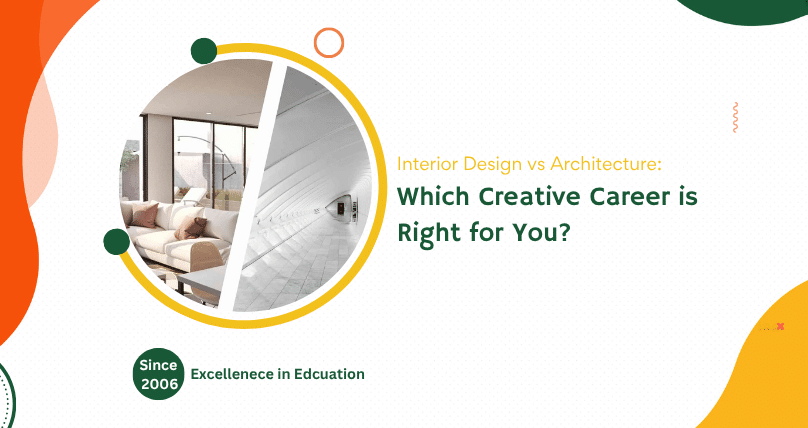
Interior Design vs Architecture: Which Creative Career is Right for You?

Ever Caught Between Two Design Worlds?

Choosing a career in the creative field is an experience similar to standing at a design crossroads: 

Should I go for Architecture, or

Should I choose Interior Design? 

Interior Design vs Architecture Which Creative Career is Right for You

At first glance, these two might be considered perfectly interrelated: they both shape spaces, work on aesthetics, and demand creativity. However, their principles, tools, and end goals are quite distinct.

At the Kalapurnam Institute, one of the best places to pursue architecture and the best interior design course in Ahmedabad, we understand the confusion faced by so many students when making this choice. This detailed blog will help untangle all differences and will help you determine which creative career is your perfect match.

Let’s Talk Definitions First

What is Architecture? 

Architecture is the science and the art of designing physical structures and buildings, a discipline that balances engineering and aesthetics. Architects essentially plan and oversee building projects and ensure that these are safe, usable, and environmentally friendly. Through their designs, they ensure how cities operate and how people live, work, and connect with their surroundings.

What is Interior Design? 

Interior Design refers to the art and science of elevating the interiors of space to create a healthier, more practical, and visually appealing space. Here, Interior designers work on layouts, materials, furnishings, lighting, and color schemes to make the dream space resonate with your lifestyle. It’s all about designing a space that speaks to the personality and purpose of the people. 

The Core Differences – A Comparative View

Factor  Architecture Interior Design
Focus Structural and external design Internal space planning and decoration
Tools AutoCAD, Revit, BIM, Sketching AutoCAD, SketchUp, 3D Max, Photoshop
Duration 5 Years (B.Arch) 3 Years (BSc or Diploma)
PCM Required? Yes Not always
Creativity Type Technical + Conceptual Stylistic + Emotional
Career Launch Slower, post-licensure or degree Quicker, freelance/project-based

Skills & Tools You’ll Use

Architects need a solid foundation in physics and mathematics, a deep understanding of construction processes, spatial reasoning, and a strong aesthetic sensibility. They rely heavily on drafting software, structural modeling tools, and compliance standards. Only the best architecture institute in Ahmedabad can teach you the standards and techniques to be a successful architect. 

Interior Designers lean on creativity, color theory, space functionality, and material knowledge. They work with software like 3D Studio Max, AutoCAD, and Photoshop to visualize ideas and often collaborate with architects and clients.

Common Workspaces

Where Architects Work:

  • Construction companies
  • Real estate development firms
  • Government planning bodies
  • Urban design consultancies
  • Infrastructure projects (airports, bridges, smart cities)

Where Interior Designers Work:

  • Residential and commercial design firms
  • Retail outlets and showrooms
  • Hospitality industry (hotels, restaurants, resorts)
  • Event and exhibition design agencies
  • Freelance or own studio

Career Paths & Opportunities

Architecture:

  • Architect
  • Urban Planner
  • Landscape Architect
  • Building Designer
  • Sustainable Design Consultant

Interior Design:

  • Interior Designer
  • 3D Visualizer
  • Space Planner
  • Set Designer
  • Freelance Consultant

How to Get Started

Becoming an Architect:

  1. Complete 10+2 with PCM.
  2. Clear NATA or JEE (Paper 2A or AAT).
  3. Enroll in a recognized B.Arch program (5-year).
  4. Optionally pursue M.Arch or PhD for specialization.
  5. Gain experience through internships and license eligibility.

Top Architecture Institutes:

  • Kalapurnam Institute (Ahmedabad )
  • CEPT University (Ahmedabad)
  • School of Planning & Architecture (Delhi)
  • Sir J.J. College of Architecture (Mumbai)

Becoming an Interior Designer:

  1. Complete 10+2 (any stream; some institutes require PCM).
  2. Clear entrance exams for design colleges.
  3. Join a B.Sc. Interior Design course or Diploma.
  4. Gain hands-on experience through internships.
  5. Choose advanced courses like M.Sc. (Interior Design) or specializations.

Top Interior Design Institutes:

  • Kalapurnam Institute – Best Interior Design Course in Ahmedabad
  • National Institute of Design (Ahmedabad)
  • CEPT University (Ahmedabad)
  • Sir JJ School of Art (Mumbai)

What Kind of Creative Are You?

Choose Architecture If You:

  • Are good with numbers and logic
  • Think in 3D
  • Enjoy structural design and planning
  • Want to shape cities and landscapes

Choose Interior Design If You:

  • Have a flair for aesthetics and color
  • Think from a user-experience angle
  • Love curating furniture, lights, textures
  • Want to transform dreams into beautiful spaces

Real Talk: What the Industry Wants

The creative industry is experiencing rapid growth in India and globally. Architecture is gravitating toward sustainable, smart infrastructure. Interior design is harnessing AI, wellness design, and modular spaces. There is a great opportunity for creative minds who can tackle contemporary spatial problems with fresh, innovative thought.

Kalapurnam Institute takes pride in being a comprehensive learning environment for both disciplines. Being the leading architecture institute in Ahmedabad and a reputable name for the study of the best interior design course in Ahmedabad, we make sure that students do their best. We provide comprehensive, technology-driven, and globally benchmarked training that equips our students with a strong foundation and advanced expertise in the subject.

Final Thoughts: Which One’s for You?

Both fields are rewarding, and your decision depends on your creative instincts, academic strength, and vision for the future.

Do you want to start designing the world from the ground up? Or do you want to transform existing spaces into something cool? 

Both careers require time and passion, but starting on the right course at the right institute is the trick to it all.

If you’re still confused, then let’s have a conversation with our experts.

Visit Kalapurnam Institute, explore our institute, talk with career counselors, and choose a program that fits your dreams. Whether it’s Interior Design or Architecture, your future in design begins here.

Book a FREE counseling session today.

Education Since
Whatsapp Icon